
My morning at the Radha Krishna Temple in Balham
I was invited by my friend, Dhruva – who owns a local shop with husband Umesh – to share a special hour with her at the ‘Radha Krishna Temple’ in Balham during the Hindu New Year, or Annakut, which is the day after Diwali. It was a truly amazing and uplifting experience.
As I entered the Temple, which was incredibly quiet considering it was on the Balham High Road, I could hear the melodic chanting of the Bhajaans and smell the fragrant scent of incense. On the left of the large room was an uncarpeted area, where we left our shoes, a cabinet with a counter top displaying leaflets, and a bowl of the most delicious Brushna – home made sweets that look like different coloured squares of caramel, but taste much better – and which are made specially for Diwali
Diwali, The Festival of Lights
Diwali, on October 28th is the last day and the most auspicious day of the Hindu year, with Annakut, or The Hindu New Year the following day on October 29th. Diwali marks the end of the financial year when business people close their books, count their blessings, and consider their spiritual relationship with God. Afterwards, Hindu families celebrate with fireworks to symbolise the Festival of Lights.
Candles for the Celebration of good over evil – and the uplifting of spiritual darkness and Diyas or kandils (colourful paper lanterns) are an integral part of Diwali decorations.

We made our way across the pale carpet in our stocking feet to the first, Temple within a Temple, which is dedicated to Radha Krishna, Krishna is the male God, on the left as we look at the temple, and Radha the female God, is on our right.
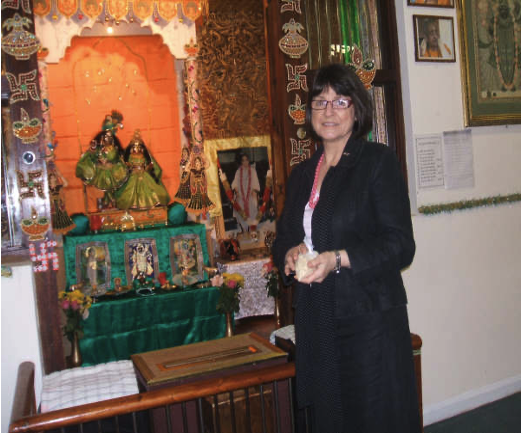
The Temple of ‘Radha Krishna’
Radha and Krishna are always dressed in matching robes. Their costumes are made of green and gold silk and the temple is decorated in vibrant orange and deep turquoise.
Lord Krishna is the leader of the Hare Krishna devotees. And although The Hare Krishna Temple is in Watford, his followers can often be seen in their long white robes and open-toe sandals chanting ‘Hare Krishna’ in London’s West End.
On the opposite side of the room, a young Priest was cleaning the Temple of a black God called Sreenathji.
‘Everything has to be clean and tidy,’ my friend told me. ‘The way you keep your house is the way the Temple should be kept – clean.’ She also said, ‘Your heart should be clean. It is no good saying something good, you must mean it and practice it. You must not smile to someone’s face and then say bad things behind their back. Nor must you ever look down on anyone, because you may be down there one day” Good advice, and similar to my Christian teaching.
We left the young Priest to it and walked down a corridor to a room where several Gods in a long glass case were having their robes changed by a lady named Gita. Gita told me she made the clothes and changed them every day – which to me, who cannot sew a button on, was a miracle. Each of the small costumes, robes, hats and shoes was made of vibrant reds, greens and gold-coloured silk.
I watched Gita change the robes of Lord Ganesh – the God who is recognised by the elephant trunk on his face, and Lord Hanuman, the mighty ape that aided Lord Rama in his expedition against evil – and is one of the most respected Gods in the Hindu pantheon. When I joined Dhruva, Gita was about to change the clothes of The Goddesses Ambagi, who sits on a Lion because that is how she travels, and her sister Khodiyaar, who travels by crocodile.
In the middle of the room – on a low table – there was a statue of Lord Shiva. Dhruva dipped a small cup into a bucket of milk and then into a bucket of water and poured it over Lord Shiva, and the animals that surrounded him.
‘Pouring milk and chanting thanks for our food and health, gives peace of mind,’ she told me. ‘Cows are sacred animals, they give us milk, and from milk we make many dairy products.’ Dhruva’s family is vegetarian, as are most Hindu families. They respect the earth and all that grows, as well as all animals.
We were washing our hands when we heard a bell ring, followed by what sounded like a dinner gong. It was a dinner gong – it was almost noon. We walked quickly down the passage and past the young male priest and an elderly woman priest who were preparing for the lunchtime Service. Gita had finished her work and followed us to the main hall. Just before the service began, Gita gave me prasaj – a small bag of holy food that is offered to God at Diwali. I felt very honoured.
The Priest hit the gong again and everyone was silent. Then the Priest lit candles and offered food to the God Sreenathji. There was singing and chanting and the Priest sat on the floor and kept the rhythm by beating a long oval drum. The songs of course were in Hindu, so I stood in the background and watched. Finally, the priest sang Bhajaans and then blessed us by flicking holy water.
The colours were amazing. Sreenathji was dressed in beautiful red and gold garments, wore the most incredible shoes and jewellery and was surrounded by Peacock feathers, which had been sent specially from India.

This priest, a Brahmin, officiated at the mid-day service.
The priest is a Brahmin, the highest of the Hindu casts, as was his father and his grandfather before him. I asked him if his son would have to follow in his footsteps and become a priest, a Brahmin, and he said no, he would support his son in whatever he wanted to do with his life. It’s an unsociable life, being a Brahmin. They can’t eat in restaurants and they can’t eat garlic or onions, in case their breath offends the Gods.
No restaurants? And worse still, no garlic? Can you imagine the uproar if British Clergy were not allowed to eat out? As for garlic – there would be riots in Rome.
*
I had a very spiritual and memorable time with my friend Dhruva, and I am grateful to her for inviting me to see her place of worship. I don’t pretend to understand the teachings of Hinduism – it would take decades. I know it is one of the largest and oldest religions in the world and has a billion followers. I also know it’s a combination of religious, philosophical, and cultural ideas and practices that originated in India – and I have learned that it is characterized by the belief in one God, Brahman, and many manifestations. It is rooted in reincarnation, the law of cause and effect, following the path of righteousness, and the desire for liberation from the cycle of births and deaths. And lastly, Hinduism is solely responsible for creating Yoga and Karma, among a dozen other original concepts.
I recently read an article by a Professor from the University of Wales College, Newport that seemed to explain Hinduism simply: “The relationship between the many manifest deities and the un-manifest Brahman (God) is rather like that between the sun and its rays. We cannot experience the sun itself but we can experience its rays and the qualities, which those rays have. And, although the sun’s rays are many, ultimately, there is only one source, one sun. So the Gods and Goddesses of Hinduism amount to thousands, all representing the many aspects of (the one) Brahman”
In the words of the Desiderata, a document found in St. Paul’s Church, Baltimore, 1692, “…be at peace with your God, whatever you conceive him to be, and whatever your labours and aspirations, in the noisy confusion of life, keep peace with your soul…”
 Madalyn Morgan
Leave a comment